Views: 0 Author: Site Editor Publish Time: 2026-10-17 Origin: Site

How Can High-End Hotel Commercial Steam Irons Truly Enhance the Guest Stay Experience?
Hotel rooms run on small promises. A firm pillow. A shower that heats fast. A mirror that doesn't fog for too long. And clothes that don't look slept in.
The last one is where properties quietly fail.
Guests don't pack a steamer. They expect the room to offer one that actually works — or at least one they can trust without a manual.
That is why a hotel steam iron should never be judged by wattage alone. The meaningful spec is how the device behaves at 7 a.m., half-awake, holding a wrinkled linen shirt with a meeting in forty minutes.
High-end hospitality isn't about the biggest machine. It's about removing friction from the morning.
Quick Answer: What Makes a Steamer “Hotel-Grade”?
There is no universal winner, but the pattern across premium properties is consistent. Guests need speed, safety, and zero learning curve. Housekeeping needs predictable behavior and easy handling. Procurement needs CE and CB evidence they can defend in front of a regional director.
A device that scores on all three is rarer than it sounds.
The Guest's Morning, Icon by Icon
· The 7 a.m. rush — a wrinkled shirt, three minutes, no manual
· Fire safety — hand-sensing stop, 8-minute dry shut-off, full power-off
· Water — a 170 mL tank that survives one shirt and collar
· Reach — a 2-meter cord that reaches the bedside outlet
· Fabric care — a ceramic soleplate and steady NTC control
Why the Traditional Iron and Board Misses the Point
An ironing board eats floor space in rooms already tight on it. It has to be pulled out, unfolded, and put away. A guest who travels light doesn't want the chore.
A handheld garment steamer changes the logic. One hand holds it. No board. The garment hangs where it is, and the steamer comes to it.
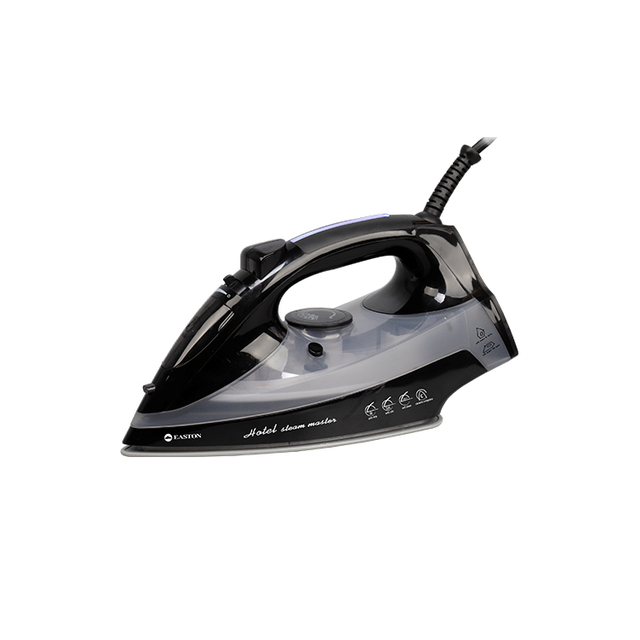
The EASTON unit leans into this idea hard. The built-in fabric auto suction holds fabric flat while you steam, so there's no pulling, no stretching, no board, and no second person. For a guest in a hotel bathrobe at dawn, that difference is the entire product.
Safety Is the Feature Guests Never See
Guests forget irons. That is a fact of hotel life.
This is where hand-sensing auto power-off earns its place. The control button is a hand-sensing switch: the moment your hand leaves the handle, the unit stops. No steam. No heat. No risk of a forgotten device staying hot against a silk blouse.
The logic goes further. In dry mode the unit auto-powers-off after eight minutes. Twenty minutes after that, it drops into full power-off with every light out. A fire-safety-minded housekeeping director reads that sequence and exhales.
How to Use a Steam Iron: Simpler Than Guests Fear
Here's the part most hotel websites never explain.
Learning how to use steam iron correctly is the single biggest reason guests call the front desk for help. The fear lives in the machine, not the fabric. A device that asks for one hand and two buttons removes most of that fear.
After heating, the steam level defaults to Off. Pick Low for delicate silk, High for cotton and linen. The steam button is hand-sensing too — steam releases the instant you select a level and stops when you let go. NTC temperature control keeps the heat steady, so there's no guessing game between too-hot and not-enough.
Water Tank and Reach: The Forgotten Specs
A steamer is only useful if the cord reaches and the tank survives a shirt.
The professional steam iron with water tank builds on a 170 mL tank in PC plastic and a 2-meter extra-long power cord. Two meters means the bedside outlet usually works without furniture gymnastics. 170 mL covers one shirt and collar in a single pass — the reason this class of device beats a travel mini-steamer that dies halfway down a sleeve.
What the Soleplate and Noise Really Do
Ceramic matters more than buyers assume.
A ceramic soleplate glides rather than drags and spreads heat evenly, which lowers the odds of a shiny scorch mark on a guest's dress. Combined with a matte black PP plastic shell, the unit stays cool to the touch on the outside and looks presentable sitting on a tray in a room photo.
Noise is a quieter selling point. At 76 dB it's noticeable enough that a guest knows it's working, quiet enough not to wake a partner in the next bed.
Comparison: Traditional Iron vs. Hotel Handheld Steamer
Factor | Traditional Iron + Board | Hotel Handheld Steamer |
Setup time | Board out, unfold, plug | Pick up, plug in |
Hands needed | Two plus a board | One |
Fabric contact | Pressing, risk of scorch | Auto-suction, glide |
Room space | Eats floor space | Fits in a drawer |
Safety | Auto shut-off varies | Hand-sensing stop |
Best for | Home pressing | In-room quick refresh |
Steam Levels in Real Guest Scenarios
Guest Situation | Steam Level | Outcome |
Silk blouse, business traveler | Low | No sheen, soft creases |
Cotton shirt, wedding guest | High | Sharp collar in seconds |
Wool jacket, evening event | Low–Medium | Lift wrinkles without flattening |
Quick touch-up before checkout | Off (dry) | Freshen without steam |
What CE and CB Do — and Don't Prove
Certification is where procurement either builds trust or creates confusion.
CE marks conformity with applicable European safety and electromagnetic-compatibility requirements for electrical equipment placed on the EEA market. CB refers to the IECEE CB Scheme, an international system where a product tested under one recognized national certification body, based on IEC International Standards, can be accepted across participating markets.
A CE and CB marking is not a claim that a steamer irons every fabric flawlessly. It is evidence that the unit meets agreed electrical-safety and compatibility requirements — exactly the assurance a hotel group needs before placing a large order.
Ask which standards were tested, which body issued the certificate, and whether the certificate covers the exact model you're buying. That one question separates a real report from a decorative logo.
Common Mistakes Hotels Make
· Mistake 1: Buying a household steamer rated for a bathroom shelf. Commercial duty cycles differ.
· Mistake 2: Skipping the cord length and forcing guests to hunt for an outlet.
· Mistake 3: Treating “handheld steamer and iron” as one generic category. No two operate the same.
· Mistake 4: Never teaching staff the 8-minute dry shut-off.
· Mistake 5: Leaving the instruction card as the only user guide.
Final Verdict
A high-end hotel's guest experience improves most when the commercial steam iron disappears into the room's routine. Not because guests notice the device, but because they stop noticing wrinkles.
· Choose a corded handheld steamer when rooms lack convenient outlets.
· Choose hand-sensing safety when fire-risk review is strict.
· Choose a ceramic soleplate when guest wardrobes include delicates.
· Choose CE/CB evidence when procurement needs defensible documentation.
The real ROI shows up on ordinary Tuesdays: a guest in a rush, a shirt that looks pressed, and no front-desk call.
Key Takeaway
The best hotel clothes steamer is not the one with the loudest wattage claim. It is the one that matches guest speed needs, housekeeping habits, room layout, fabric risk, and certification standards. A quiet, safe, one-handed steamer with a real water tank turns a crumpled morning into a small act of care — and that is exactly what guests remember.
FAQ — 7 Questions Hotels Actually Ask
1. How should hotel guests use a steam iron safely?
Wait for the heating indicator to turn solid, keep the hand-sensing switch held, and set Low for delicates. The unit stops the moment your hand leaves it.
2. Can a handheld steamer replace an ironing board in a hotel room?
For most garments, yes. The built-in fabric auto suction holds fabric flat, so most wrinkles release without a board. Heavy creases on thick trousers may still want a press.
3. How long does the water tank last per garment?
The 170 mL tank typically covers one shirt and collar in a single pass at a standard steam level.
4. Why does hand-sensing auto power-off matter in a hotel?
It stops a forgotten device from staying hot. The unit cuts off the moment your hand leaves it, adds an 8-minute dry shut-off, and drops to full power-off 20 minutes later.
5. What do CE and CB certifications actually confirm?
CE confirms conformity with applicable European electrical-safety and EMC requirements; CB reflects the IECEE CB Scheme for acceptance across participating markets. Neither is a fabric-performance claim.
6. Is the 76 dB noise level a problem in a quiet room?
No. It is audible enough to signal operation but low enough not to disturb a sleeping partner in the same room.
7. What is the best way to store the steamer between guest stays?
Drain and dry the tank, store the matte black unit in a drawer or closet shelf, and coil the cord loosely rather than tightly.