Views: 0 Author: Site Editor Publish Time: 2026-11-04 Origin: Site

Guests rarely remember a kettle. They remember the scalding splash, the burnt-plastic smell at midnight, the flat-tasting tea. That is why hotel electric kettles have quietly become a competitive detail instead of an afterthought. This guide unpacks how a genuinely commercial unit—the EASTON ES1011, to name one—shifts a stay from "acceptable" to "worth returning to."
Triple safety—auto shut-off, boil-dry protection, overheat protection—removes the human-error gamble from every room.
Food-grade 304 stainless steel with a seamless tank protects water purity and shortens housekeeping turnover at the same time.
Double-wall heat insulation plus a two-stage lid are the two features guests actually feel: touch-safe walls and a splash-free pour.
Certifications such as CE and RoHS are the procurement baseline that shields your liability, not a marketing afterthought.
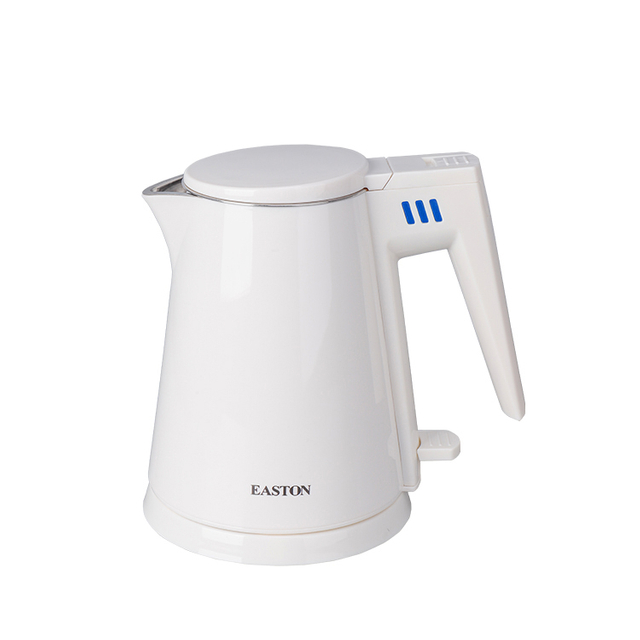
A guest does not watch a bimetallic thermostat flip. She watches the steam—and whether the shell stays cool enough to touch. Ordinary domestic units keep radiating heat long after the boil. The ES1011's double-wall heat insulation structure, a stainless tank wrapped in a hollow insulating layer beneath the food-grade PP shell, keeps the matte black body touch-safe mid-boil. That single detail changes how a parent manages a curious toddler near the tray, and how a sleepy guest pours at 5 a.m. without a glove.
Comfort is more than skin temperature. The two-stage lid design handles the two moments guests actually fumble: filling and pouring. First stage opens wide for easy filling and dead-angle-free cleaning of the inner tank; second stage throttles the pour so hot water does not splash and steam does not curl into the face. Small engineering, outsized relief.
Three separate protection circuits govern this machine. Nothing exotic—just reliable, redundant logic.
Protection | Trigger | What It Spares |
|---|---|---|
Auto Shut-off | Steam at boil (100 °C) | No endless boiling, no wasted energy |
Boil-dry Protection | Element heat spike | The element, the base, the desk beneath |
Overheat Protection | Abnormal temperature rise | The wiring, the room, the insurance claim |
A guest can switch the unit on and walk into the shower. That is not negligence; it is human nature. Commercial-grade units are engineered on the assumption this happens every single night—and they absorb it gracefully. Domestic units assume the opposite.
Materials do the marketing you cannot say out loud. The ES1011 runs a food-grade 304 stainless steel inner tank—BPA-free, free of substance precipitation at high temperature, and safe for drinking water. A seamless tank resists dirt build-up, so limescale never hides in welded seams.
Seamless means easier cleaning. Which matters more than it sounds.
Housekeeping turnovers run on minutes. A tank with joints becomes a daily descaling project; a seamless inner tank shrugs. Certification speaks to a different audience—your insurer, your auditor, your procurement review. Demand CE and RoHS on every unit, and treat region-specific marks like LFGB (German food-contact) and FDA (U.S. food-contact) as the gold standard for a property hosting international guests. Uncertified electronics are the fastest way to void hospitality insurance coverage.
Most "hotel kettles" are repackaged domestic units that die by month three. A real commercial unit survives thousands of cycles. But even the best hardware needs routine care—and that is exactly where staff and guests intersect.
Descaling is the silent killer of shut-off accuracy. Scale blocks the steam channel, delays the trigger, dulls the boil-dry response. Every operator should know how to clean electric kettle interiors with a simple citric-acid rinse once a month—not because the unit fails fast, but because a slow failure is harder to spot. The same electric water heater kettle that serves black tea at breakfast doubles as a bottle-warmer for families; treat it well and it keeps both jobs quietly.
Limescale also stains perception. When the water tastes metallic, guests blame the hotel, not the geology. Food-grade steel changes that equation.
Criterion | Typical Domestic Unit | EASTON ES1011 (Commercial) |
|---|---|---|
Inner tank | Welded or coated | Seamless 304 stainless steel |
Safety | Auto shut-off, sometimes | Triple: shut-off + boil-dry + overheat |
Insulation | Single wall | Double-wall hollow insulation |
Lid | Single-stage | Two-stage anti-splash, anti-steam |
Base | Fixed cord | 360° rotatable detachable base |
Lifespan under hotel use | Weeks to months | Years, thousands of cycles |
The table is blunt on purpose. When two kettles cost the same, the difference is not wattage—it is the base. The 360° rotatable detachable base suits left- and right-handed guests alike and makes lifting and pouring natural from any angle. A 1850 W element brings the 1.7 L large capacity electric kettle to boil fast, and the electric cordless tea kettle format keeps the tray tidy and the cord out of the way.
Enhancement is not a luxury feature list; it is the absence of small failures. A touch-safe wall, a splash-free pour, a tank that stays clean, a machine that never burns the room—that is what commercial hot water pots deliver quietly, every night. Guests may never name it. They simply book again.
Q: How do hotel electric kettles differ from a normal household kettle?
A: Commercial units use food-grade 304 stainless steel, triple safety protection, and double-wall insulation, and they are built to survive thousands of cycles of heavy, often careless, use. Domestic models are not rated for that workload.
Q: Is the ES1011 safe if a guest forgets to add water?
A: Yes. Boil-dry protection monitors element temperature and cuts power the moment it spikes, so the unit cannot run dry into a fire hazard.
Q: Does the double-wall design really keep the outside cool?
A: The hollow insulating layer between the stainless tank and the PP shell keeps the matte black body touch-safe even while the water is boiling.
Q: How should hotels clean electric kettles without damaging them?
A: Fill with water and food-grade citric acid, bring to a boil, let it sit, then rinse thoroughly. Never scrub the 304 surface with abrasive pads, and avoid harsh detergents that leave residue.
Q: Can the kettle run on standard hotel wiring?
A: The ES1011 is rated 220–240 V, 50–60 Hz at 1850 W, matching most hotel circuits. Always verify local voltage before bulk ordering.
Q: Which certifications should a procurement team demand?
A: At minimum CE and RoHS. For international guest properties, prefer units that also meet LFGB or FDA food-contact standards, and a brand that discloses its 304 stainless steel sourcing.
Q: How long does a commercial kettle last in a hotel?
A: With monthly descaling, a commercial-grade unit typically runs thousands of boiling cycles—roughly three to five years of daily room use—versus weeks to months for a domestic model.