Views: 0 Author: Site Editor Publish Time: 2026-06-02 Origin: Site

Walk into any premium boutique room and you will notice one appliance quietly shaping the entire stay: hotel commercial mini fridges. Guests rarely praise them out loud. They simply sleep deeper, grab a cold sparkling water at midnight, and leave a five-star review without quite knowing why. Yet procurement teams still buy residential bar fridges, wake up to compressor rattle at 2 a.m., and discover frost build-up that housekeeping cannot clear between turnovers.
The right mini hotel refrigerator is invisible by design. It is silent, energy-frugal, and merchandises itself through a glass front. This guide answers one question: how exactly do high-end commercial units improve the guest experience, and what specs should procurement lock into the next PO?
Key Takeaways
Silence is a luxury feature — a 100% silent compressor protects sleep quality far more than a faster cooling cycle.
Automatic defrosting eliminates maintenance drag — no more 2-hour melt-downs between guest arrivals.
Reversible door + optional lock means the unit fits any wardrobe bay and protects minibar stock.
✅ CE marking and the CB Scheme are the baseline for international properties; domestic marks void cover.
0.27 kWh/24h is the new benchmark for 40L in-room cooling.
Hospitality is judged on friction points. A dripping tap. A squeaking hinge. A fridge that clicks on exactly when a jet-lagged traveler finally drifts off.
Hotel mini fridges built on residential compressors emit 38–45 dB of mechanical hum. That is louder than a library. It penetrates through a wardrobe wall and into the pillow. Multiply that across 200 rooms and you have a systematic guest satisfaction score leak that surveys will never quite name.
Commercial-grade units like the EASTON ES7633 run completely silent. The compressor cycles without audible vibration, so guests can rest through the night. That single feature does more for repeat bookings than any pillow menu.
Visual merchandising matters. A solid white appliance tucked in a cupboard is a forgotten appliance.
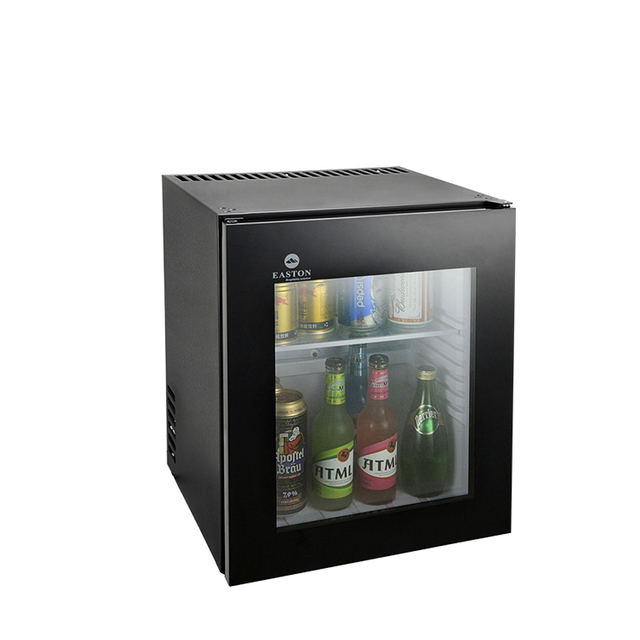
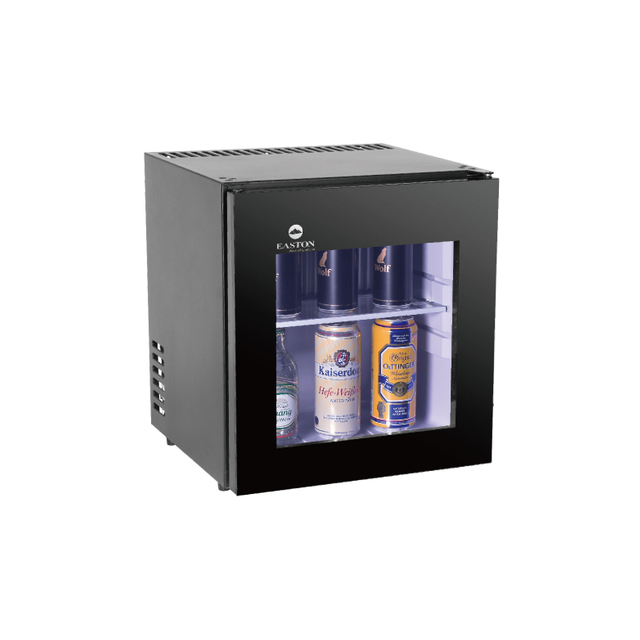
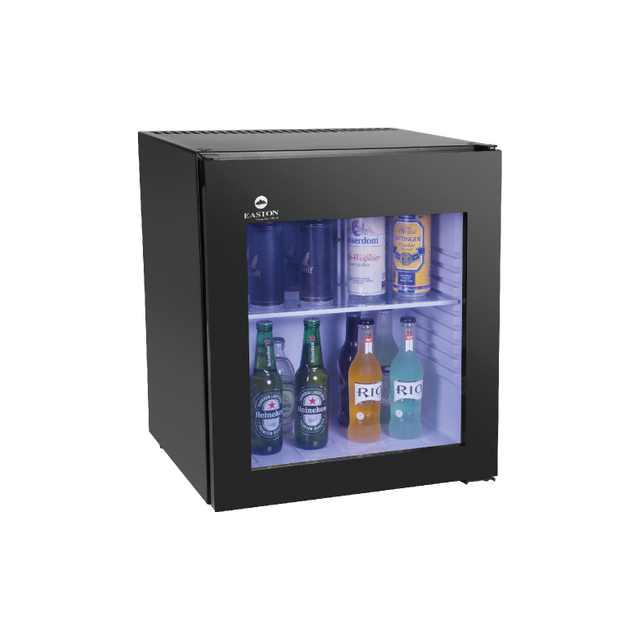
A black mini fridge with glass door flips the logic. Guests see the water, the juice, the craft soda the moment they enter the room. The interior LED light with low rated power acts like a display case after dark. Cold bottles behind tinted tempered glass look curated, not cluttered.
Guest behavior | Solid-door minibar | Glass-front commercial fridge |
|---|---|---|
Sees stock on arrival | No | Yes, immediately |
Buys a drink at midnight | Has to open door, may wake partner | Glances through glass, silent |
Photos for social media | Ugly white box | Premium black display |
Restocking time | Staff guesses levels | Visible at a distance |
The commercial unit is not just a fridge. It is a silent revenue assistant.
Here is a question every housekeeping director knows: how to defrost a small refrigerator without leaving a puddle in the wardrobe bay?
Residential units frost up in weeks. Staff must power them off, leave the door open, and wait hours. Ice sheets behind the shelves hide mould. Guest rooms sit offline. Turnover slows.
The ES7633 uses automatic defrosting. The evaporator cycles through melt periods on its own. No towels. No downtime. No mystery puddles. Housekeeping simply wipes the adjustable tempered glass shelves and moves on.
This is the difference between an appliance that supports operations and one that creates extra work.
Marketing language is cheap. Numbers are not. Below are the operating parameters EASTON writes into every ES7633 built for boutique and luxury properties:
Parameter | EASTON ES7633 Value |
|---|---|
Capacity | 40 L |
Cooling range | 11–13 °C / 14–16 °C |
Power supply | 220–240V, 50/60 Hz, 58W |
Daily consumption | 0.27 kWh / 24h |
Noise output | 100% silent during operation |
Dimensions (W×D×H) | 400 × 435 × 540 mm |
Net weight | 14.5 kg |
Plug option | UK or Euro |
Door | Reversible, glass front |
Lock | Available on request |
Certification | CE + CB Scheme |
A few notes worth unpacking:
The 11–13 °C / 14–16 °C band is the correct minibar range. Colder, freezer-like settings over-freeze bottled drinks and waste energy.
0.27 kWh/24h means roughly 8 kWh per month per room. Across 150 rooms, that is a measurable energy efficiency line on the utility bill.
The reversible door swings left or right. Installers fit it into any wardrobe configuration without reworking the joinery.
The optional door lock prevents guest tampering during high-turn seasons.
CFC-free refrigerant aligns with green procurement policies and ESG reporting.
Insurance inspectors and brand-standard auditors do not care about marketing copy. They care about marks.
CE marking confirms the unit meets European health, safety and environmental protection standards. The CB Scheme (Certification Bodies' Scheme) goes further: it is an international mutual recognition framework that lets one test report unlock approvals in 50+ countries. For chains operating across the UK, EU, Middle East and Southeast Asia, that single mark collapses the compliance paperwork.
Plug compatibility follows the same logic. The ES7633 ships with a UK or Euro plug to match the property's market. No cheap travel adapters in guest rooms. No burnt sockets.
Procurement teams sometimes default to retail units because the sticker price is lower. Over a five-year horizon, the math flips.
Cost factor | Residential bar fridge | Commercial hotel mini fridge |
|---|---|---|
Upfront unit cost | Lower | Higher |
Compressor lifespan | 1–2 years | 5+ years |
Noise complaints | Frequent | Rare |
Manual defrost downtime | 3–5 hours per event | Zero |
Warranty in commercial use | Voided | Honored |
Certification | Domestic only | CE + CB |
Typical replacement rate | High | Low |
The cheaper unit almost always ends up more expensive.
A great in-room fridge does its job invisibly. It keeps drinks at 11–13 °C, hums at zero decibels, clears its own frost, and merchandises minibar stock through a tinted glass front. It carries the marks that keep insurers quiet and the plugs that keep electricians calm.
When procurement next reviews the room amenities, skip the retail aisle. Spec a 40L commercial unit with automatic defrosting, silent operation, a reversible door, and dual certification. Guests will not comment on the fridge. They will comment on how well they slept.
A: 11–13 °C (drinks zone) or 14–16 °C (minibar zone). Colder settings over-freeze bottled water, stress cans and waste electricity.
A: The evaporator cycles through short melt periods automatically. Staff do not need to power the unit off, chip ice, or lay towels. Just wipe the adjustable glass shelves between guests.
A: Yes. The tinted glass acts as a display case for minibar stock, and the black frame matches modern boutique interiors far better than white residential boxes.
A: Commercial units offer a door lock on request. Housekeeping controls the key, protecting stock during high-turn seasons.
A: The EASTON ES7633 uses 0.27 kWh/24h. Over a month that is under 9 kWh per room — a fraction of a residential bar fridge.
A: Not with an auto-defrost commercial unit. If you inherit an older solid-frost model, the safe method is power off, leave the door open, and catch melt water with towels — never use a knife on the ice.
A: CE marking is the European compliance mark. The CB Scheme is international mutual recognition; one CB report supports approvals across 50+ markets, which matters for global chains.
A: Commercial units like the ES7633 run at 100% silent operation. Residential compressors typically hum at 38–45 dB, which is audible throug