Views: 0 Author: Site Editor Publish Time: 2026-11-09 Origin: Site

Guests rarely praise a fridge in a review. They punish it: frost on the glass, a rattle at two in the morning, a bottle that never got cold. One of those becomes a paragraph on a travel site, and the paragraph outlives the stay by months. That is why hotel mini refrigerators now act as brand evidence rather than a line on the spec sheet.
Sourcing is usually the culprit. A property buys retail cabinets because the invoice looks sensible, then finds they suit a kitchen running a few hours a day, not a room running around the clock. Domestic units cycle loud, frost over in humid air and change model number every season, so the spare ordered later no longer fits the niche.
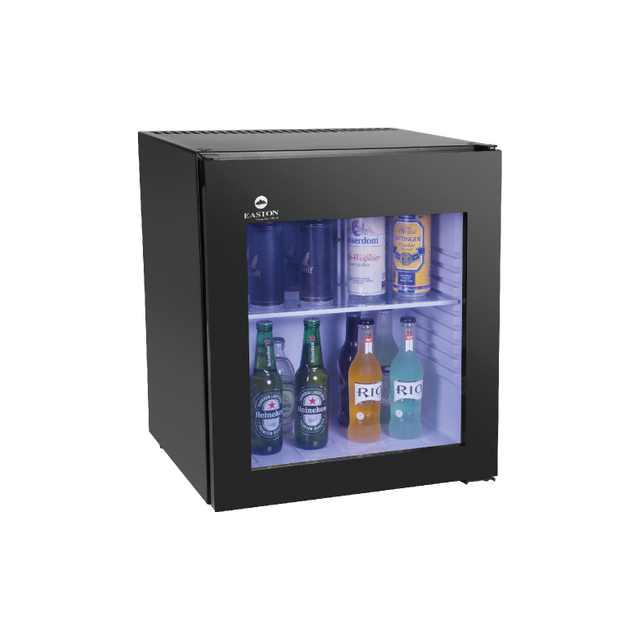
A commercial 60L glass door cabinet answers most of that: no compressor, its own defrost cycle, low draw, one footprint for years. Below: where the upgrade shows for guests, how the systems compare, and what procurement should put in writing.
❄ Silent cooling · ⚡ 1.45 kWh/24h · Low-power LED · Lock ready · Reversible door
Compressor-free absorption cooling removes the start-up clatter that wakes light sleepers.
Automatic defrost keeps the pane clear, so housekeeping never strips a unit between departures.
1.45 kWh/24h at 60L supports energy reporting without a premium budget.
CB, GCC and RoHS paperwork belongs on the datasheet, not in a sales email.
Sound is the first thing guests notice and the last thing they forgive. No compressor, no thump every ten minutes, no hum through a pillow — two metres from the bed, that decides whether somebody sleeps.
Frost comes next. In humid air a manual-defrost cabinet ices over within weeks, so housekeeping spends fifteen minutes per room with a scraper and a towel, and the early arrival still meets a fogged pane. Across a hundred rooms that labour bill beats the retail price gap.
Energy settles it too. A unit rated at 0.9 kWh in a laboratory will not hold that in a 28°C room where the door opens twenty times at turndown, while an energy efficient mini refrigerator stays close because the load was engineered. Retail ranges also refresh endlessly, and parts pipelines close while the furniture contract runs.
Two systems dominate, and neither suits every property.
An absorption circuit chills through heat and a refrigerant pair instead of a pump, so there is almost no noise and no vibration. Pull-down is slower, but a guest room is not a bar. Draw stays modest and few parts move. Right for suites, spa floors and rooms where the bed sits close.
Compressor cabinets reach temperature quickly and hold it under turnover, suiting a minibar restocked several times a day. The cost is acoustic: a small compressor in a silent bedroom is audible, and vibration on a timber plinth amplifies it. Specify anti-vibration mounts and a night mode if you go that way.
Table 1 — Cooling systems side by side
Feature | Absorption cabinet (60L EASTON ES7660) | Compressor cabinet |
|---|---|---|
Noise in a quiet room | ❄ Effectively silent, no compressor | Audible cycling at night |
Pull-down to 5°C | Slower, steady | Fast |
Rated draw | ⚡ 85 W at 220–240 V | Higher start-up surge |
Daily energy | 1.45 kWh/24h | Load-dependent |
Moving parts in the loop | None | Compressor and fan |
Best room type | Suites, quiet bedrooms, spa | High-turnover minibar floors |
Arrival is the cheapest one. A chilled bottle behind the pane reads as care, and the glass lets guests look without opening the door, so a steadier band.
Late arrivals want something cold when nobody answers the phone, and the 5–7°C setting handles that without freezing the fruit.
Medication is the moment that matters most to a few guests and appears in no brochure: insulin, expressed milk, baby food — a band that stays put, no ice build-up.
Longer stays bring skincare, wine from the vineyard, leftovers. The 8–12°C band is gentler, so textures and aromas survive the night.
Suites add the ceremonial layer, and there the glass door minibar reads as furniture rather than an appliance wheeled in from a stockroom.
Table 2 — Matching the thermostat band to the guest
Thermostat band | What guests typically store | What the band protects |
|---|---|---|
5–7°C | Water, beer, soft drinks, dairy, insulin, baby food | Consistent cold without freezing produce |
8–12°C | Wine before service, chocolate, skincare, fruit | Gentle chill, no texture or aroma damage |
An electronic thermostat with two selectable bands plus automatic defrost takes the scraper off the trolley, and frost-free running protects the evaporator from the efficiency loss ice causes.
Tempered glass shelves should adjust, since bottle heights vary by market. Low-wattage LED keeps the interior legible without adding heat, and a lock on request covers revenue control. Hinge direction follows the layout, so specify a reversible door; the mini refrigerator single door format keeps the elevation simple.
At W490 × D490 × H580 mm and 23.5 kg it fits a 500 mm niche — confirm the clearance the manual asks for. Power is 220–240 V, 50/60 Hz at 85 W, with a UK or Euro plug per market. Compliance is where buyers get careless: the CB Scheme certificate tested to IEC 60335-2-24, the GCC conformity mark naming the model, a RoHS directive declaration and a CFC-free statement. A lab name such as TÜV Rheinland lets you check the certificate number, not just a cover page.
Housekeeping routine. A one-page card: torch the gasket, wipe the interior monthly, log defrost faults rather than hiding them.
Lock discipline. A lock protects revenue only when keys are signed out; reconcile the issue log against restock counts or shrinkage shows up as unexplained loss.
Par stock. Hold 3–5% par stock plus gaskets and clips, or a failure leaves a niche empty for a week.
Common mistake: ordering before confirming niche depth and clearance on the drawing. Common mistake: buying on unit price, then finding the plug needs adapters. Common mistake: assuming a domestic warranty survives twenty-four-hour use.
Start with a listening test. Let a sample run overnight in a quiet office, measure it at one metre, open the door twenty times and watch recovery. A PDF cannot tell you what a light sleeper hears at three in the morning.
Then verify the paper chain: CB report number and standard, GCC certificate listing your model, RoHS declaration, plug standard. Scanned originals in one email are a different risk category from documents promised after the deposit.
Finally, do the arithmetic. A mini electric refrigerator drawing 85 W is a light load, but check it against your circuit budget per block, then ask for a written parts commitment — five years is realistic, three is a warning.
Choosing hotel commercial mini refrigerators comes down to decisions that are hard to reverse: cooling method, thermostat bands, hinge, paperwork, parts. Get them right and the cabinet vanishes into the room.
Match the cooling system to the room, not the catalogue.
Insist on automatic defrost and a two-band thermostat before price.
Confirm niche, clearance and plug against your own drawings.
Verify CB, GCC and RoHS by number, and keep spare gaskets.
The best cabinet is the one nobody mentions. It just makes the room feel considered.
A: Yes, when set correctly. The 5–7°C band keeps water, beer and dairy properly cold, while 8–12°C suits wine and skincare. Absorption units recover more slowly after opening; they do not run warmer.
A: Rated at 1.45 kWh/24h, roughly 530 kWh annually in continuous service. Compare that with a compressor cabinet drawing 2.2–2.6 kWh/24h in a hot room; across hundreds of rooms the difference usually carries the business case.
A: Guests see the contents without opening the cabinet, so less cold air is exchanged and the band stays stable. Restocking is visible at a glance, and the minibar reads as a display rather than a closed white box.
A: A CB report tested to IEC 60335-2-24, a GCC conformity mark naming the model, a RoHS declaration and a CFC-free refrigerant statement. Ask which laboratory issued the report and check the certificate number.
A: At W490 × D490 × H580 mm and 23.5 kg it suits a 500 mm niche. Leave the clearance stated in the manual and check the door swing against the niche wall. A reversible hinge helps, but cannot rescue a shallow niche.
A: A lock is available on request, keyed per cabinet or on a master key. Pair it with a signed key log reconciled against restock counts, or it controls access without controlling loss.
A: Plan on 3–5% par stock plus gaskets, shelf clips and one spare thermostat. In a 300-room property that is nine to fifteen cabinets, cheaper than an empty niche on a sold-out weekend.