Views: 0 Author: Site Editor Publish Time: 2026-10-21 Origin: Site

Hotel room supplies are the quiet infrastructure of every great stay. Guests rarely notice the electric kettle on the tray, the minibar humming in the cabinet, or the room safe tucked behind the wardrobe. They notice, immediately, when any of them fail.
That is the hidden reality that serious hotel supplies suppliers operate under. The product must disappear into the background while still performing flawlessly—thousands of times a day, across hundreds of rooms, across years of renovation cycles.
EASTON is preparing to welcome buyers at EquipHotel Paris. If you are speculating guestrooms, sourcing OE replacements, or consolidating a fragmented vendor list, our booth is where procurement conversations get shorter and more concrete.
A common mistake is treating hotel room service supplies as a purchasing checklist. Kettle. Hair dryer. Iron. Safe. Minibar. Mirror. Bin. Tick the boxes.
But a real guestroom is an integrated operating system.
The electric kettle tray must match the visual language of the desk. The minibar noise level has to sit below what light sleepers register. The hair dryer wattage needs to satisfy a business traveller rushing to a meeting without tripping the room circuit. The room safe must accept a 14-inch laptop, not only jewellery.
A luxury hotel amenities supplier solves these as one problem, not seven.
Let's map the room honestly:
Guestroom Zone | Typical Product | Operational Priority |
Nightstand / writing desk | Electric kettle, welcome tray, cups, capsule coffee | Noise, boil-dry protection, cleaning access |
Wardrobe / cabinet | Room safe, minibar | Fit clearance, energy rating, decibel level |
Bathroom | Wall-mounted hair dryer, LED makeup mirror, weighing scale | Heat safety, cord length, IP rating |
Open area | Ironing centre, steam iron, ironing board | Stowage, heat isolation, guest intuition |
Entry / vanity | Foot-pedal waste bin, sign stand, service cart | Soft-close, footprint, finish durability |
This is the range EASTON designs, customises, and ships from a single factory floor. We describe ourselves as a global hotel room total solution provider—not a catalogue reseller.
The welcome tray is the first product a guest touches after dropping the luggage.
It sets the temperature—literally and emotionally. A matte-black 1200W kettle with coordinated cups, a universal capsule coffee option, and a clean tray edge communicates that the property pays attention. A scratched plastic kettle, mismatched cups, and a loose cord communicates the opposite.
EASTON's matt-black kettle line, paired with capsule-coffee compatibility, was developed specifically for branded groups that want consistency across 200+ rooms without colour drift between shipments. The cup, the tray insert, and the water bottle holder are designed as one visual unit.
Most guests cannot tell you what their minibar sounds like on the second night.
They can, however, tell you if it kept them awake on the first.
This is why spec sheets should list decibel ratings, not just volume and temperature range. A 25L automatic-defrost minibar in the wrong location becomes a maintenance call. In the right specification, it disappears into the cabinetry.
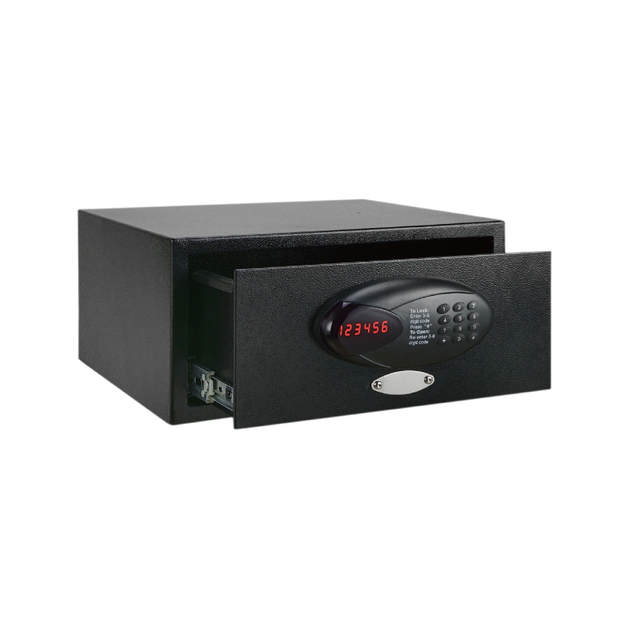
Travellers now carry a 14-inch laptop, noise-cancelling headphones, a passport, and cash. A safe that only accepts jewellery is functionally obsolete.
Deep-fit digital safes with an internal drawer are the realistic baseline for upscale properties. The lock mechanism, the emergency override procedure, and the wall-mount hardware matter more than the outer paint colour.
Wall-mounted hair dryer units in 1500W ionic configuration, LED makeup mirrors with 3x magnification, and slim precision bathroom scales are small. Each one, however, generates a complaint the moment it underperforms.
Specify heat auto-shutoff. Specify cord length. Specify mirror colour temperature. These are not luxury requests—they are the difference between a five-star stay and a housekeeping ticket.
This is the table procurement teams usually argue over:
Criterion | Single total-solution supplier | Multi-vendor purchase |
Lead-time consolidation | One schedule, one container | Multiple POs, multiple shipments |
Visual consistency | Brand-aligned finishes across categories | Finish drift between vendors |
Spare-parts logistics | Single contact, unified warranty | Fragmented after-sales |
Custom ODM support | Coordinated design language | Inconsistent customisation |
Unit price vs. total cost | Slightly higher SKU price, lower TCO | Lower sticker, higher handling cost |
The calculation changes when a renovation programme spans 5, 20, or 200 rooms. That is the moment hotel procurement made easier stops being a tagline and becomes a measurable saving.
A catalogue full of logos is meaningless unless each mark is tied to the correct component.
CE marking for EU market access
CB scheme reports for cross-market electrical safety recognition
GCC (G-Mark) for Gulf regulatory entry
RoHS and REACH for restricted-substance compliance
LFGB for food-contact items such as kettles and cups
SGS and Intertek third-party test reports
ISO 9001 quality-management system at factory level
CCC for China-market internal sales
EASTON runs ten dedicated safety-test streams across its electrical and hospitality ranges. The right buyer question is not "do you have certificates?" but "which certificate covers which SKU, and can we see the actual test report?"
Since our foundation, EASTON guestroom products have reached more than 100 countries and regions, serving over 3,000 star-rated properties—including St. Regis, Hyatt, Hilton, Sheraton, Westin, Marriott, Wyndham, IHG, and W Hotels.
That scale matters because procurement becomes simpler only when a supplier has already absorbed the complexity. We are your guestroom specialist, not a middleman learning your brand on your project timeline.
If you are walking the show, come to our booth. Bring your room plan. Bring your finish mood board. Bring the problematic category from your last renovation.
We will work through:
OS&E proposal alignment per room type
ODM customisation against your supplied sample
Lead time, packaging, and spare-parts policy
Technical documentation matching your brand QA standard
Make hotel procurement become simpler. That is the whole point of the conversation.
We get asked the same handful of things every show. Here are the straight answers—no brochure language.
What's the real MOQ?
Short version: it depends on the item. A catalogue kettle in off-the-shelf black? We've shipped 50-piece runs for small boutique properties. A custom-matched enamel tray with your logo and a specific Pantone colour? Different conversation—tooling and colour-consistency runs push the number up, usually to a level that makes a full container load worthwhile. Honest answer: send your room count and we'll tell you straight whether you're in catalogue territory or ODM territory. No need to pretend.
Can you actually match our brand colour?
Mostly yes, and here's how it works. You send the physical sample—or at least a Pantone reference plus a photo under daylight lighting—and the custom team builds a tooling draft around it. Tray inserts, cup bodies, kettle shells, even the outer carton print can follow your brand book. What we won't promise is a perfect colour match from a JPEG scraped off your hotel website. That ends badly for everyone.
How do you handle compliance for the EU vs. the Middle East?
This is where a lot of small suppliers trip up. Each SKU has its own certification file. For Europe you're looking at CE, CB, RoHS, REACH, and for anything touching water or food (kettles, cups) LFGB. For the Gulf it's the GCC G-Mark scheme. Third-party reports come through SGS or Intertek, and the factory runs on ISO 9001. Ask us which report covers which model—we hand over the actual PDF, not a logo sheet.
Lead time—realistically, when can we get containers?
Catalogue items move on the usual production cycle. Customised projects? Count on sample approval first (that's the slow part), then tooling, then production, then container booking. The honest headache most buyers hit isn't production—it's the shipping window. We work backwards from your soft-opening date and tell you if the timeline is comfortable or tight, before you commit.
What happens when one kettle breaks six months in?
Matters more than people think. A lot of suppliers will happily sell you 400 kettles and then shrug when you ring up about a burnt-out one. We keep spare parts on the shelf—heating elements, lids, power cords, tray inserts—and our 9S service covers post-sales response. The point is: one broken item shouldn't mean replacing the whole tray set.
Renovation or new build—which do you do better?
Honestly, renovation projects are the trickier ones, and we like them. New build gives you a blank room. Renovation means matching a five-year-old finish from a supplier who may no longer exist. Our custom team does this regularly—reverse-engineering an existing tray colour, reproducing an older ironing-board cover, matching a minibar footprint under a built-in cabinet. That's the kind of work that separates a catalogue vendor from an actual specialist.
Besides kettles, what else do you actually make in-house?
Welcome trays and kettles, minibars (including the 25L auto-defrost line), wall-mounted hair dryers, digital room safes, ironing centres and steam irons, soft-close waste bins, LED makeup mirrors, bathroom scales, sign stands, and service carts. One roof, one QC team, one warranty contact. That's the whole pitch.