Views: 0 Author: Site Editor Publish Time: 2026-11-26 Origin: Site

A guest lands at 11 p.m., misses dinner, and only wants hot water for a cup of tea before sleeping. Nobody calls the front desk for that. They walk to the tray, fill the jug, press the switch, and a couple of minutes later the room stops feeling like a transaction. That single scene is the whole argument for hotel electric kettles — and it is also why the cheapest line on the tender sheet is rarely the cheapest decision.
Guests form their opinion of housekeeping from things they can touch. The kettle is one of the very few appliances a guest handles bare-handed, with no remote, no app, no instruction card worth reading. So the details register: does the handle feel solid, does the lid open without a fight, is the outside too hot to hold, does the water taste of plastic.
Three moments repeat in almost every property:
arrival, when the first cup is part of settling in;
late night, when someone wants instant noodles or a baby bottle;
early departure, when one cup has to happen before the airport transfer.
Get these right, and the room feels cared for. Get them wrong, and you inherit a one-line review that outranks every upgrade you paid for. This is why electric kettles for hotel rooms are usually specified by engineering and housekeeping together, not by interior design alone.
"High-end" has less to do with marble than with the absence of friction. A commercial hot water pot that behaves predictably is a quiet luxury. A retail jug that rattles, drips and smells is a loud failure.
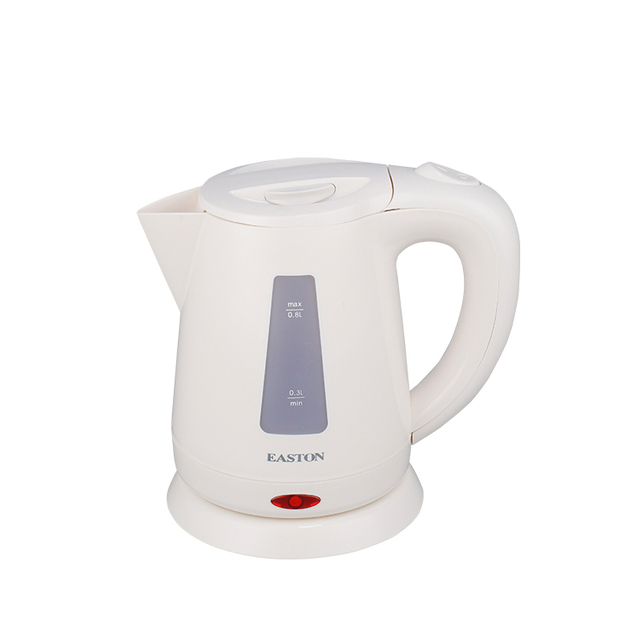
Double-wall insulation is the most persuasive safety detail in a guest room. On this class of unit the outer skin stays comfortably warm rather than scald-hot, so a parent carrying a toddler, a guest reaching for the jug in the dark, or a housekeeper wiping a tray is never one careless second away from a burn claim.
Then comes the part nobody sees: a genuine Strix controller rather than a generic thermostat. That is the difference between a kettle cutting out cleanly at boiling point and one that keeps cycling until the plastic smells. Add boil-dry protection and auto shut-off, and you have covered the scenario every operator knows too well — an exhausted guest switching on an empty unit at 3 a.m., then falling asleep.
⚡ 1000 W · cool-touch outer wall · auto shut-off · boil-dry cut-out · ♻ retractable cord · CCC / CE / CB
Here is how do you clean the inside of an electric kettle, answered honestly: with a seamless #304 stainless steel tank and a concealed heating element, there is nothing to dig at. No exposed coil to scrub around, no welded seam collecting scale, no plastic liner holding on to yesterday's masala chai. A soft cloth, warm water, and a citric-acid descale once the water level gauge begins to show a chalk line — that is the entire procedure, and it takes under a minute per room.
Compare that with a glass body that displays every smudge, or a plastic tank that has absorbed the smell of instant soup. Multiply the difference by rooms per night, and the labour argument makes itself.
0.8 L is a deliberate figure. It reaches a rolling boil quickly on 1000 W, which is also why a hotel water kettle of this size plays nicely with older 220–240 V room circuits that already carry a hairdryer. No tripped breaker at 6 a.m. No engineer callout.
The jug lifts off a 360° base, so it can be set down from any angle in the dark. The cord retracts into the body, which keeps the presentation tray looking arranged rather than improvised. This is the practical reason so many properties now specify cordless electric tea kettles for suites and club floors — and why a travel water kettle electric specification also makes sense in serviced apartments and crew rooms, where the same tray is packed and reset every day.
Two finishes, black and moon grey, sit calmly beside black ABS trays and dark stone counters; UK or Euro plugs mean one product family can cover most of a portfolio.
Retail jug | Hospitality-grade unit | |
|---|---|---|
Boils per day | 1–2, careful owner | 8–15, tired strangers |
Wetted surface | plastic or exposed coil | seamless #304, concealed element |
Outer wall at full boil | hot to the touch | cool-touch double wall |
Typical failure | cracked lid, dead element | clean cut-out, jug replaced alone |
Cord | fixed, always on show | retractable, cordless base |
Feature | What the guest feels | What the hotel gains |
|---|---|---|
Double-wall body | "I can hold this without flinching" | fewer burn incidents, calmer housekeeping |
Seamless tank | "it looks new, not scrubbed" | fewer hygiene escalations |
0.8 L + 1000 W | "hot water, quickly" | fewer room-service top-ups |
Strix controller | nothing — by design | fewer electrical callouts |
Water gauge | nothing | planned descaling instead of complaints |
Ask for mark numbers, not just logos. This model carries CCC, CE and CB approvals, which is what allows a group with properties in several regions to buy one specification without re-testing locally. Request the reports and confirm they match the exact plug and voltage variant you are ordering — a certificate issued for a different cord set is not a certificate for your order.
Also ask:
Can replacement jugs be ordered separately from bases?
Can the base be wired or asset-tagged for loss control?
What descaling interval fits your local water hardness?
Will both finishes and both plug types stay in production for the life of the programme?
Then run a sample floor. Give four units to housekeeping for a month before committing a tower. They will find the awkward lid, the short cord, the spout that dribbles — long before your guests do.
EASTON Hotel electric kettles earn their place in a room by removing risk, noise and doubt rather than by adding features. A cool-touch double wall, a seamless #304 tank, a real Strix controller, and a 0.8 L body on 1000 W cover the three moments that decide a stay: arrival, late night, early departure. Buy on total cost of ownership, sample before scaling, and let housekeeping sign off. The kettle is rarely the reason a guest books again — but it is very often the reason they remember the room kindly.
1. What makes hotel electric kettles different from a supermarket kettle?
Duty cycle, controller grade and cleanability. A guest-room unit may boil ten times a day in unskilled hands, so it needs a commercial thermostat, a cool-touch body and an interior that housekeeping can wipe in under a minute.
2. Does the double-wall body really stay safe to touch?
The outer shell stays comfortably warm instead of scald-hot while the inner tank holds boiling water. It keeps heat in the water longer and keeps hands off the heat source — the reason double-wall is now standard on club floors.
3. Why 0.8 L and 1000 W rather than 1.7 L and 1500 W?
Smaller volume boils faster, wastes less water, fits a standard tray, and draws less current on shared room circuits. Guests rarely need more than two cups at once.
4. How often should an in-room kettle be descaled?
Follow water hardness, not the calendar: soft water every few weeks, hard water weekly during peak season. The water level gauge makes the chalk line visible before a guest notices it.
5. Is a cordless jug a theft risk?
Less than you would expect — the jug is useless without its base, and bases can be wired or tagged. Pair cordless convenience with asset records rather than fixing cords to furniture.
6. Which certificates should a purchasing team request?
CCC, CE and CB are the baseline for this category. Ask for the test report and certificate number, check the applicant name and cord-set variant, and keep the file with the purchase order.
7. Can we order different plugs and colours?
UK and Euro plug versions are both offered, in black and moon grey. Confirm the mix at the sampling stage so the production run matches your regional rollout.
8. What is a realistic replacement strategy?
Budget for jug-level replacement instead of full-set replacement, and keep a small buffer of jugs per hundred rooms. Interchangeable parts are what keep a fleet consistent across a multi-year refresh.