Views: 0 Author: Site Editor Publish Time: 2026-09-01 Origin: Site

Most hotels treat a crib as a courtesy, a nice-to-have they wheel out when a family asks. The properties actually growing family-travel revenue treat hotel baby cribs like infrastructure, because guests book around them. Watch a parent at the front desk with a toddler on their hip. They're not checking the thread count. They're checking whether the room can be made safe tonight. That question comes first.
We're not going to sell you on luxury. We're going to talk about what a properly built wooden baby crib has to actually survive: dozens of guests a year, harsh disinfectants, constant folding, and one careless moment that becomes a liability claim. If that sounds unglamorous, good. It should.
Key Takeaways
Crib quality shows up in reviews before it shows up in your P&L.
An adjustable height baby crib with locking castors saves real time. Housekeeping moves it, locks it, done.
A documented EN 716 or ASTM F1169 report beats any brochure.
The mattress, not the frame, is what usually gets replaced first.
The Hidden Cost of the "Almost Right" Crib
Nobody wakes up planning to buy a dangerous crib. It happens in small compromises. A mattress that sits loose and leaves a gap at the edge. Slats spaced a couple of millimetres too far apart. A wheel that skids on polished floors instead of locking. Each one looks like a minor detail until a child is involved. Then it's an incident.
I'll say it plainly: entrapment, tip-over, and falls are the three failure modes specialists keep warning about, and every one traces to a detail that looked unimportant at purchase.
Parents arrive already tired and a little anxious. The minute they find a bedside crib for baby that sits flush against the parent bed, most of that melts. It becomes a two-line review. A return booking. The kind of word-of-mouth you can't pay for.
For the hotel, the math is colder. One incident means insurance filings, regulatory questions, and a reputation hit that outlives the year. Add the quiet housekeeping drain, chasing wobbling frames, tracking missing mattress pads, and the cheap option was never cheap. High-end hospitality baby cribs exist to kill these failure points before they become incidents.
What a Proper Hospitality Crib Actually Does
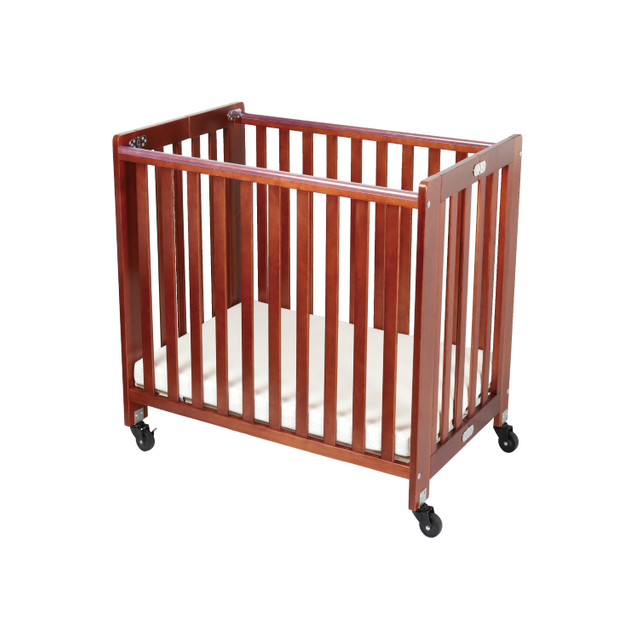
Take the EASTON ES6112 as a working example. Its European beech wood frame is dense and stable, and it doesn't warp the way softer woods do under daily humidity swings. The rounded edges and flush joints are there for a reason: they're the difference between a surface a child can bump and a pinch point they can catch a finger in.
Two height settings. High so a parent doesn't stoop to the floor, low for safer sleep. A full-size mattress (950 × 610 × 60 mm) fits the frame properly, no gaps. Four 2.5-inch lockable castors. Push it to the window for a nap, lock it, done. When checkout hits, the whole thing folds flat instead of eating corridor space.
Table 1 — Core Features of the EASTON ES6112 Hospitality Crib
Feature | What it does | Guest + hotel impact |
|---|---|---|
European beech wood frame | Dense, warp-resistant, stable | Years of use in humid rooms |
Two adjustable heights | High for lifting, low for sleep | Easier for parents, safer for babies |
Full-size mattress 950×610×60 mm | No edge gaps | Eliminates entrapment risk |
4×2.5″ castors, 2 lockable | Glide and lock in seconds | Faster room turns, fewer injuries |
Compact folding design | Stores flat | Saves corridor and storage space |
Safety, Compliance, and the Paperwork That Actually Matters
Here's where a lot of buyers get talked past. Safe sleep isn't a slogan; it's a published standard with numbers behind it. When you're evaluating a supplier, you want EN 716 (Europe's cot standard), ASTM F1169 (the U.S. full-size crib standard), and CPSC enforcement under CPSIA on paper. A lab like SGS, TÜV Rheinland, or Intertek signing off is worth more than any marketing claim in the deck.
A safe unit layers its protection in order:
Stable base and anti-tip geometry. Wide stance, low centre of gravity, so a toddler pushing on the rail doesn't tip it.
Rounded edges, concealed fasteners. Nothing sharp within reach, nothing to catch a sleeve or a finger.
Correct slat spacing and mattress fit. Gaps too small for entrapment, mattress snug enough not to shift.
Positive locks. Castors that lock decisively, a folding frame that can't collapse on its own.
The certificate is the shortcut. FSC-certified beech plus a real EN 716 test report answers most due-diligence questions up front. Guests searching for cribs wooden beds to babies won't know these names. The hotel that does? That's the one they trust.
Hotel-Grade vs. Consumer Crib: A Buyer's Checklist
Honestly, the marketing sounds the same. The load-bearing details don't.
Table 2 — Hotel-Grade Crib vs. Consumer / Portable Crib
Checkpoint | Hotel-grade crib | Consumer / portable crib |
|---|---|---|
Frame material | Dense hardwood (European beech) | Lightweight softwood or plastic |
Castors | 4×2.5″ with 2 positive locks | Static or single-lock |
Mattress | Full-size, fitted, replaceable | Thin or mismatched pad |
Folding cycle | Rated for daily folds for years | Occasional home folds |
Certification | EN 716, ASTM F1169 documented | Often unclear |
Ask the questions that make salespeople uncomfortable. How many fold cycles is the frame rated for? Which standard was the EN 716 test run against? Who paid for the certificate, an independent lab or the supplier's own department? Vague answers usually mean a vague product.
Housekeeping Realities
Engineering can't save you from a tired housekeeping team. That's why folding isn't a convenience feature. It's a safety feature. A baby crib with wheels that locks cleanly and folds flat saves a few minutes a room. Over a year, that's days of recovered labour.
Cleaning matters equally. A sealed non-toxic finish stands up to the disinfectants guest rooms get, and the removable mattress can be rotated, aired, and swapped on a schedule. Train staff to lock castors before cleaning, check slat gaps monthly, retire cracked units on sight. A cracked crib isn't a repair ticket. It's a liability decision.
Conclusion
Treat the crib like infrastructure, because that's what it is. It turns anxious parents into repeat guests, keeps housekeeping safer, and keeps one bad incident from undoing a year of good reviews. When you vet suppliers, ask for EN 716 and ASTM F1169 documentation, insist on independent third-party testing, and confirm the FSC story on the wood.
Here's your homework, and it's a ten-minute task. Pull your crib inventory this week. Ask for the test reports. Walk one room and look at the crib the way a parent will, because that's exactly who's looking when they decide whether to book.
FAQ
Q1: Are hotel baby cribs safe for newborns? A: They are when they meet EN 716 and ASTM F1169 with a firm, properly fitted mattress. Keep the crib away from windows, cords, and anything a toddler can climb. That's the short answer; the test reports are the proof.
Q2: What's the difference between a hotel crib and a home crib? A: Rotation. A commercial crib is built for daily folding, disinfecting, and dozens of different babies a year, denser wood, lockable castors, a replaceable full-size mattress, and a folding frame rated for constant use. A home crib isn't.
Q3: How often should a hotel baby crib be inspected? A: Monthly at minimum, plus a quick visual check before each check-in. Lock the castors, check the slat gaps, confirm the mattress fits, and retire anything cracked on the spot.
Q4: Can the mattress be cleaned between guests? A: Yes. Wipe it with an approved disinfectant, let it air, and rotate or replace full-size removable mattresses on a schedule. It's one reason the mattress being full-size and removable matters.
Q5: Do hotels have to offer cribs for free? A: No policy forces it, but free cribs are a proven booking driver. Families often filter by this amenity before they even look at the room rate.
Q6: Which certifications should a hotel demand from a crib supplier? A: EN 716, ASTM F1169, and CPSIA/CPSC compliance, backed by third-party reports from a lab like SGS, TÜV Rheinland, or Intertek, plus FSC documentation if they claim certified wood.
Q7: How many height settings does a hospitality crib really need? A: Two, minimum. A higher setting so parents don't bend to the floor, and a lower setting for safer sleep. That balance is what makes it usable day and night.